


Discover how effective Mac support for business can prevent costly delays and improve productivity.

November 26, 2026
Standardizing on Google Workspace or Microsoft 365 can quietly shrink the pool of IT vendors able to support your business later. This often leads to fewer choices and higher support costs years after the initial decision.
When a business standardizes on a single email and collaboration platform, the real cost often isn't visible on day one. It shows up later, when outside IT help gets harder to find and more expensive to hire.
A single sentence insight: Picking one platform over the other can quietly limit your future IT support options without you realizing it.
Both Google Workspace and Microsoft 365 handle email, file storage, collaboration, and day-to-day productivity reliably, and each has its own strengths, which is why the decision so often gets treated as a matter of preference or price. More than 58% of companies use Microsoft 365 and Teams, while only 29% rely on Google Workspace — a gap wide enough to shape which systems IT providers in any given market actually know well.
That gap matters more than it seems, because the consequences of this decision don't show up right away. Years after you pick a platform, you may find that your options for outside IT help have quietly narrowed, and the rates for support have crept up as a result.

Standardizing on either Google Workspace or Microsoft 365 does more than settle which tools your team opens every morning. It also sets the requirements for anyone who will later work on, support, or troubleshoot those systems, which means the choice quietly shapes your access to outside IT contractors down the line.
Most IT professionals specialize in one platform rather than both. So as your business grows or your needs shift and you want to bring in outside help for projects, troubleshooting, or migrations, the size of your options depends on how common your platform is locally — if fewer providers support it in your area, your pool of available experts shrinks accordingly.
That narrowing rarely announces itself. It tends to surface only when you need urgent help or try to negotiate support rates, and at that point you might find fewer companies able to take on your work, with those who can charging more simply because competition is thin.
Standardizing on a single platform can quietly reduce the number of vendors able to support your business. When most providers in Rochester Hills focus on one system, businesses running the other are left choosing from a smaller list.
That shortage of options carries a direct cost: support prices tend to climb over time. Without a broad pool of vendors to choose from, you lose the leverage to negotiate better rates or switch providers easily, which makes budgeting for IT support less predictable and can slow your response time whenever issues arise.
If you're considering a platform switch or planning for long-term growth, it's worth asking: how many local IT providers truly support the platform you're considering?
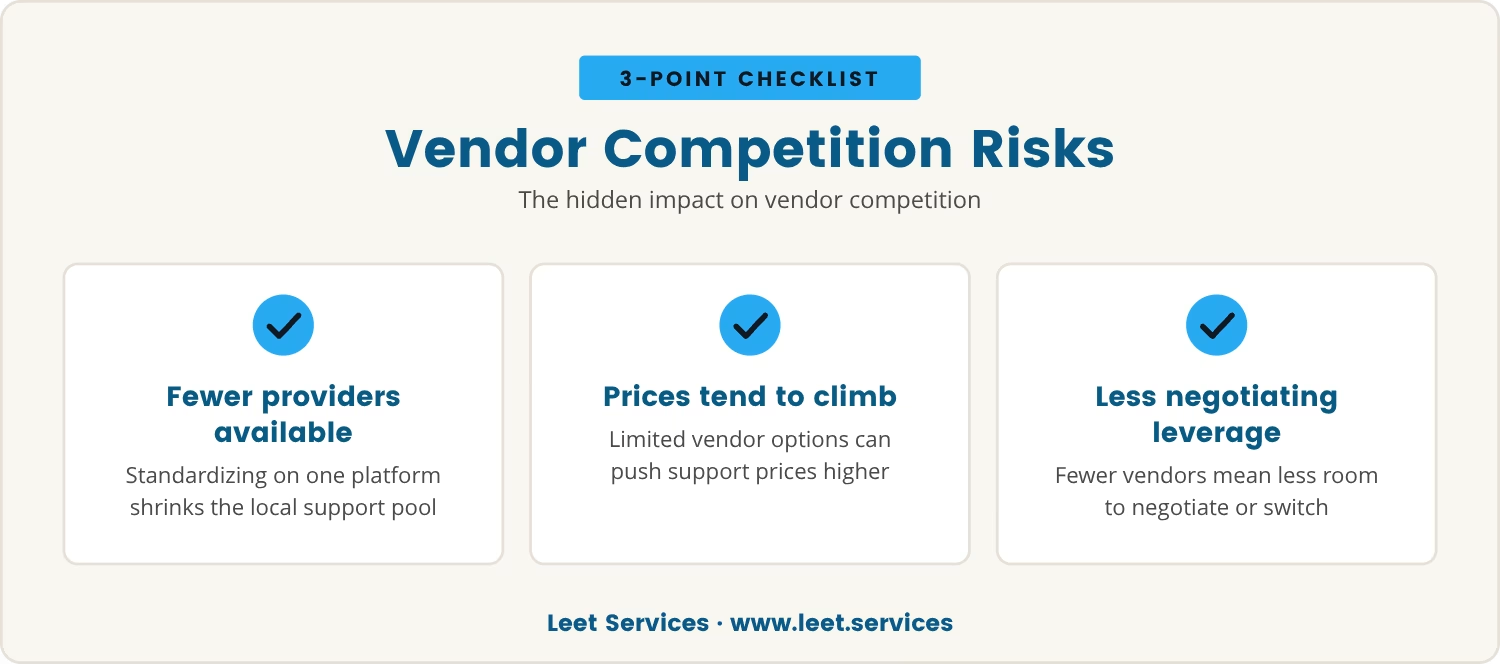
The platform you choose today can shape your business's flexibility for years afterward. Here's how that plays out in practice:
As your business grows, you'll need IT professionals who know your chosen platform inside and out. That expertise isn't always easy to find, especially if you're running the less common system in your region.
When only a handful of vendors can support your platform, you lose the ability to compare rates and negotiate. That imbalance can quietly drive up your support costs over time.
Moving from Google Workspace to Microsoft 365, or the other way around, can turn into a complex and expensive project. A thin pool of available experts only makes the transition harder.
With fewer providers available, you might wait longer for help exactly when you need it most. That delay can affect business operations and customer satisfaction alike.
Some advanced features or integrations are only supported by certain providers, so if your platform isn't widely supported, you may end up adjusting your plans or settling for less ideal solutions.
In Rochester Hills, IT support availability varies by platform. Where most local providers lean toward Microsoft 365, businesses running Google Workspace may have a harder time finding help.
Several forces push this narrowing along. IT providers tend to invest in training and certifications for whichever platform is most in demand locally, so over time more providers become experts in the dominant system while fewer keep pace with the alternative.
At the same time, the tools and integrations built around Google Workspace and Microsoft 365 aren't always interchangeable — a provider skilled at managing Office 365 may not be nearly as comfortable with Google Drive or Google Meet, and the reverse holds just as true. That specialization narrows the pool further still.
And as your business grows, its needs tend to grow more complex alongside it: advanced features, security requirements, and integrations with other business systems all demand deep platform knowledge, so if your chosen system is less common, finding providers who can deliver that level of support gets harder.
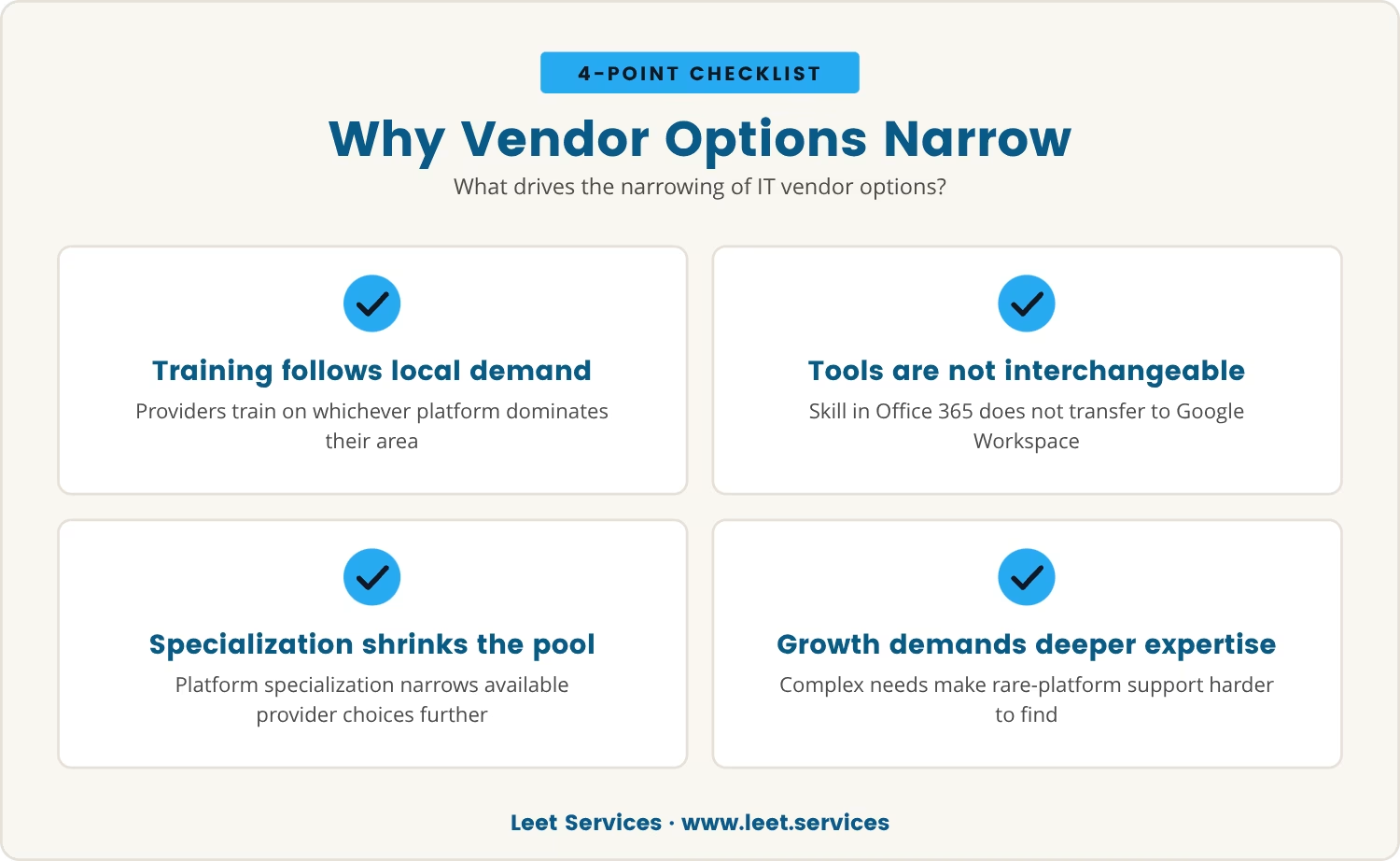
A few warning signs tend to show up before the cost becomes obvious:
Planning ahead is the simplest defense. Before committing to Google Workspace or Microsoft 365, research which platforms local IT providers in Rochester Hills support most, ask potential vendors directly about their experience with both systems, and weigh the long-term impact on your support flexibility before you sign anything.
If you're already committed to one platform, keep watching the local market. Check periodically whether new providers are entering the space, and maintain relationships with more than one support company, since that gives you more leverage when negotiating rates or planning future projects.
The choice between Google Workspace and Microsoft 365 is about more than features or price. It's a decision that can quietly shape your business's access to outside IT help, vendor competition, and support costs for years to come.
Understanding that hidden consequence now is what makes it possible to avoid the surprise later.

If your business has 15 to 80 employees, you may not realize how your choice of platform could affect your ability to get outside IT help later. At Leet Services, we see how this decision can quietly limit your options and raise your support costs.
We invite you to talk with us about how we approach long-term flexibility and what that could mean for your business setup.
Try us risk-free: if you and your team aren’t ecstatic with Leet Services in your first 30 days, we’ll refund your entire initial investment—no questions asked.
If only a few local IT providers are willing to work with your chosen platform, or if the quotes you receive for support run higher than expected, you may already be seeing the effects of a limited vendor pool. Asking providers directly about their experience with your platform, and comparing how they respond, is a reliable way to check.
Besides Google Workspace, some businesses consider open-source solutions or hybrid setups that combine different tools. These alternatives can carry their own support challenges, though, so it's worth checking how many local providers are familiar with them before making a switch.
Yes — each platform has its own ecosystem and preferred integrations, and while both offer a wide range of compatible apps, some integrations work exclusively or simply better with one system. Reviewing which business apps you depend on and confirming their compatibility is worth doing before committing.
Getting full value from real-time collaboration starts with training your team on the platform's tools, such as Google Docs or Microsoft Teams, and backing that up with resources for troubleshooting common issues. The more comfortable your team becomes with these features through regular use, the more value the platform delivers.
Look for IT providers who can demonstrate real experience with the specific advanced features your business relies on, whether that's security features, custom integrations, or business email management, and ask for references or case studies that back up their expertise in those areas.

My interest in technology began early, back in 1993 with a Macintosh SE. By the age of ten, I had already built my first PC, and within a few years, I was repairing and upgrading computers for people in my community. At fifteen, I started LEET Services, taking on IT work even before I was old enough to drive. A request to help a local business with their IT marked a turning point, leading me from home calls into the world of business technology.