.svg)

Discover how insider threats can erode vendor and partner trust, and learn practical steps to prevent long-term fallout from these security risks.

October 16, 2026
Vendor and partner trust is often damaged by insider incidents for far longer than customer trust. Businesses may regain client confidence quickly, but preferred access to suppliers and partners can be lost for years.
It's widely assumed that a data breach hits customers hardest and heals once they're reassured. In practice, the more serious damage often lands on vendors and partners, and it lingers far longer.
That's because these relationships absorb the shock differently. Even when customer trust bounces back fast, the trust built with the businesses that supply you, distribute for you, or partner on projects can take much longer to repair.
The source of that damage has a name: insider threats, security risks that come from people already inside your organization, like employees or contractors. These incidents can involve theft, sabotage, or accidental leaks, and they often target your most valuable data. Seeing why that matters is the first step toward protecting the business, since the fallout reaches well past the initial breach.

An insider attack usually raises customer trust as the first worry, yet the damage to vendors and partners can cut deeper still. These relationships rest on a shared assumption about how carefully you handle sensitive data and guard intellectual property.
Vendors and partners extend special access or share proprietary information because they trust your security measures to hold. Once an insider incident occurs, that assumption cracks, and it signals that your internal controls may not be as strong as they believed. From there, they start questioning whether the relationship should continue at its current level.
Customers may come back once they see the problem fixed, but partners and suppliers respond differently: they often restrict your access or rewrite the terms of your agreements. Some start looking elsewhere entirely. The preferred access you lose in that moment can stay lost for years, weighing on how smoothly you operate and how well you compete.
Insider threats don't all carry the same weight, and some varieties damage business relationships far more than others. Seeing the differences explains why certain incidents leave lasting scars while others fade quickly.
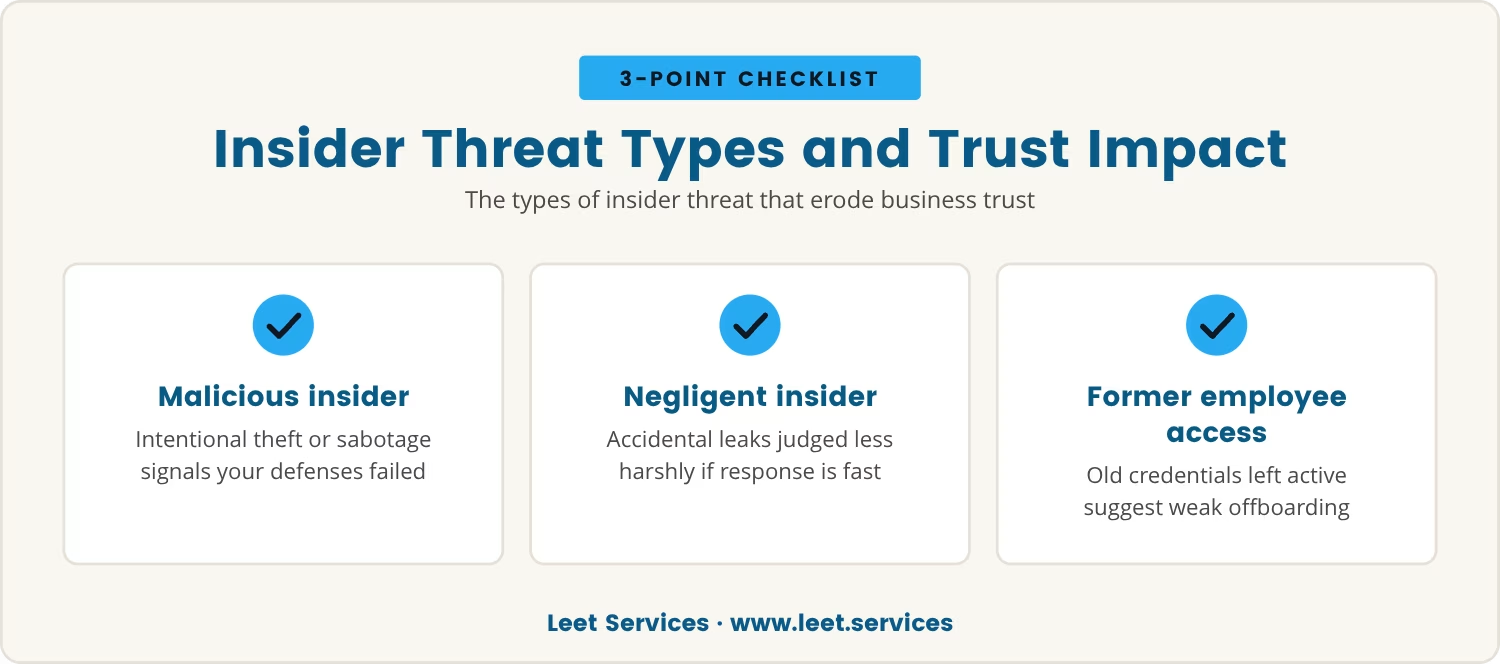
A malicious insider, such as a disgruntled employee, might steal trade secrets or sabotage systems outright. This kind of insider threat cuts deepest because it shows clear intent alongside a failure to catch risky user behavior in time. Partners reading about it tend to conclude that your company can't protect what they've entrusted to it.
Negligent insiders present a softer version of the same problem, accidentally leaking data by ignoring security policies rather than acting with intent. Even so, partners often judge these incidents less harshly, provided the response is fast and the security awareness training visibly improves afterward.
Former employees add a third layer of risk, particularly when their access isn't cut off promptly. A former employee logging in with old credentials points to weak threat detection and sloppy offboarding, and partners take note. The natural response is hesitation about sharing information with you going forward.
Businesses in Rochester Hills feel the effects of insider threats through the local business networks and supply chains around them. Many companies here depend on close partnerships with suppliers, distributors, and service providers, which means word of an incident doesn't stay contained for long.
Once an insider incident occurs, it tends to travel fast through those same networks, and partners grow cautious fast, especially on hearing about a data breach or insider attack from someone outside your organization. In response, they may tighten their own cybersecurity requirements or demand extra proof that your security team has closed the gap.
Local regulations and industry standards add another layer of pressure, shaping how quickly a response is expected. Falling short of those expectations only makes rebuilding trust with nearby partners that much harder.
Losing the confidence of vendors and partners can disrupt a business for years past the initial event. Here's how insider threat incidents create lasting challenges:
After an incident, partners may restrict your access to their systems or data, making it harder to collaborate as you did before.
Vendors might update contracts to include more demanding security requirements, audits, or penalties for future incidents.
When trust is broken, partners may slow down or pause joint projects, causing delays that impact your operations and revenue.
Word of an insider attack can spread, making other potential partners wary of working with you or sharing sensitive information.
You may need to invest more in cybersecurity tools, threat detection, and legal advice to meet new partner demands and restore confidence.
Customers are usually the first group that comes to mind after a data breach, wanting reassurance that their information is safe and a clear account of what happens next. Open communication, a fixed problem, and visibly improved security measures go a long way, and many customers give a business another chance on that basis alone.
That recovery tends to move quickly, partly because customers often have few alternatives or little appetite for the hassle of switching providers. Visible changes help too: new security awareness training or updated privacy policies give them something concrete to point to when confidence returns.
Vendors and partners, by contrast, look past the surface fixes. What they want is evidence that internal controls are genuinely effective and that the root cause of the insider incident has been addressed, not just patched. Until lasting change is visible, they tend to hold the previous relationship at arm's length.
Acting now heads off the long-term consequences that insider threats otherwise leave behind. Consider these practical steps:
The immediate disruption of an insider incident is rarely the hardest part to manage. What lingers longer is the doubt sitting with vendors and partners well after customers have been squared away, and that lingering doubt narrows opportunities and slows growth.
Protecting the company's future means building strong internal controls and keeping communication open with business partners at every stage. The relationships a business relies on most are, time and again, the ones insider threats put most at risk.

If you’re managing a team of 15 to 80 employees, you know how quickly an insider incident can shake confidence among your partners and vendors. At Leet Services, we understand how important these relationships are to your business.
Let’s talk about how we approach insider risk, and how a conversation about your current setup could help you protect your most valuable business connections.
Try us risk-free: if you and your team aren’t completely satisfied with Leet Services in your first 30 days, we’ll refund your entire initial investment—no questions asked.
Common indicators include unusual access to sensitive data, downloading large amounts of information, or accessing systems at odd hours. Sudden changes in user behavior, like bypassing security controls or ignoring company policies, can also signal a potential insider threat. Monitoring these indicators helps a security team respond quickly.
Promptly removing access for employees who leave the company is essential, including updating passwords, disabling accounts, and collecting company devices right away. Regularly reviewing user permissions helps prevent former employees from becoming a source of insider incidents.
Partners often share intellectual property or sensitive information, so a malicious insider threat can directly impact their own business. Doubts about whether internal controls are strong enough to protect what matters most to them tend to lead to stricter requirements or limited collaboration.
Security awareness training helps employees recognize risky actions and understand the importance of following security policies. This reduces the chance of accidental data leaks and makes it easier to spot intentional insider attacks before they cause serious harm.
Insider threat incidents involve people who already have access to systems, such as employees or contractors, while external cyber threats come from outside hackers trying to break in. Both are serious, but insider incidents can be harder to detect because the attacker is already trusted inside the organization.
.avif)
My interest in technology began early, back in 1993 with a Macintosh SE. By the age of ten, I had already built my first PC, and within a few years, I was repairing and upgrading computers for people in my community. At fifteen, I started LEET Services, taking on IT work even before I was old enough to drive. A request to help a local business with their IT marked a turning point, leading me from home calls into the world of business technology.