
Explore IT budget planning and discover how recurring OpEx can lead to unexpected costs. Learn to align spending with business goals effectively.

November 4, 2026
Switching everything to recurring IT payments can quietly raise your total technology costs over time. Aiming for lower up-front expenses often means paying more in the long run than a single purchase would have cost.
A subscription model works by trading one upfront payment for a stream of smaller ones, and that stream doesn't stop once the gear would have been paid off. The monthly fee stays on the books for as long as the service runs, which is exactly where the math can turn against you.
A one-time purchase may look expensive at first, yet ongoing subscriptions and service contracts can add up to more than the original equipment cost over several years. That arithmetic is worth sitting with when you're making decisions about IT budget planning for your organization.
Smoothing out cash flow and reducing short-term risk is what most companies are chasing when they make this switch. Even so, the long-term impact on your budget can be surprising if you don't look closely at the full picture, and understanding how these choices affect your bottom line is essential for making smart, sustainable decisions.

Switching from CapEx to OpEx is often framed as a way to dodge large, unpredictable expenses: instead of buying hardware or software outright, you pay a monthly or yearly fee for access or support. That trade can feel safer, particularly if a sudden, unplanned cost is what worries you most.
The catch is that these recurring payments rarely go away. Over time, they quietly harden into a permanent part of your operational costs, so what started as a way to control spending ends up locking you into a cycle of payments that never stops.
Picture a business in Rochester Hills that signs up for a cloud service instead of buying new servers. The monthly fee looks manageable at first, but stretched across several years, the total spend can climb well past what the original purchase would have cost — especially if the service bundles in features nobody uses, or the vendor raises prices along the way.
Because of that pattern, the budgeting process needs to account for these commitments as long-term obligations, not short-term conveniences. Otherwise, you risk trading one big bill for a series of smaller ones that never stop.
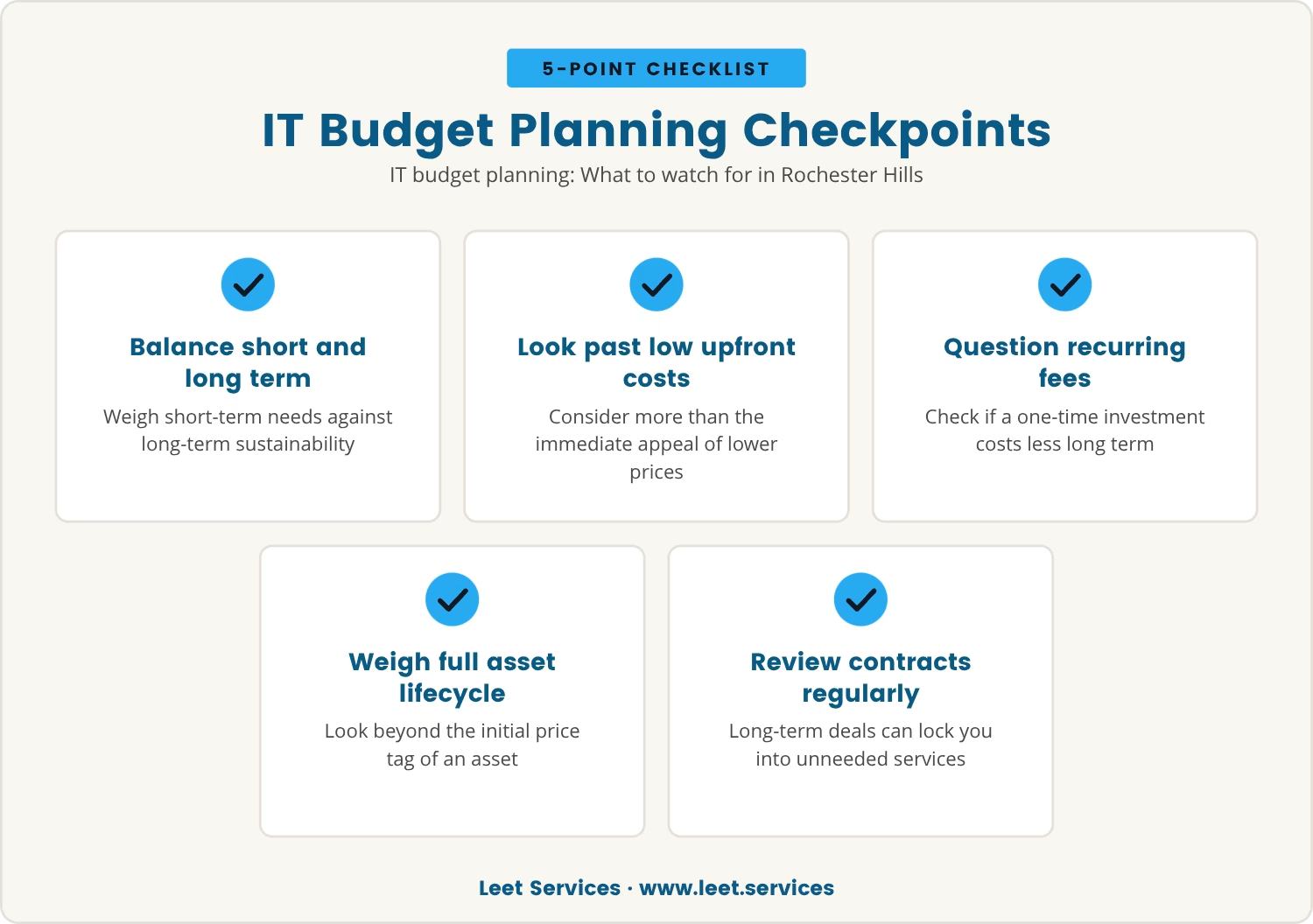
Shifting everything to opex makes your IT budget look more predictable in the short term. That predictability, though, can mask the true cost of your technology choices.
Recurring expenses are easy to overlook precisely because they blend into your regular budget cycles. As new subscriptions and services get layered in, your total monthly spend creeps upward without ever drawing attention, which makes it harder to prioritize spending or spot where money could be saved.
Left unchecked, this turns your budget management process reactive instead of strategic. Rather than aligning IT investments with business goals, you may end up simply paying bills as they land, and that habit limits your ability to invest in new projects or respond to unforeseen challenges.
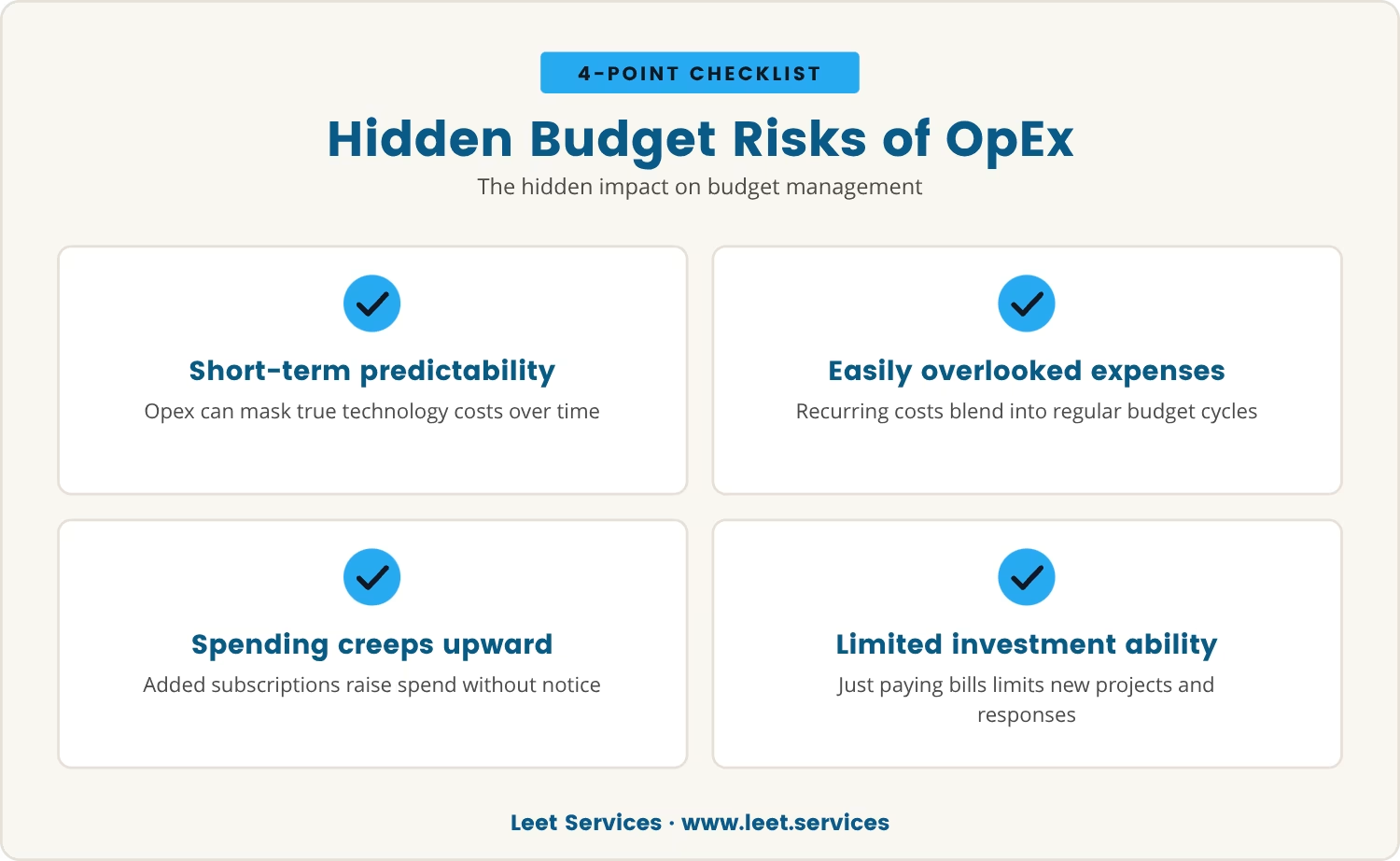
Businesses in Rochester Hills face the same pressure as companies everywhere: balancing short-term needs against long-term sustainability. Planning an IT budget with that balance in mind means looking past the immediate appeal of lower up-front costs.
Ask whether recurring fees are genuinely necessary for every service or tool in use, and whether some of them would cost less over time as a one-time investment instead. Weighing the full lifecycle of a technology asset, not just its initial price tag, is what that question demands.
Reviewing contracts and service agreements on a regular basis follows naturally from that same logic. Some providers offer discounts for longer commitments, but those deals can lock you into paying for services you no longer need, so the budget planning process should build in regular audits of ongoing expenses.
Seeing the true cost of an IT choice means looking past the sticker price to four components underneath it.
A one-time capex purchase can be expensive, but it ends once payment is made. Recurring opex subscriptions continue indefinitely, often costing more in the long run.
Capex items may require periodic maintenance, while many opex services fold support into the monthly fee. What matters is comparing total cost of ownership, not just the initial price.
With capex, you control when to upgrade or replace equipment. Opex models can force upgrades on a set schedule, sometimes before the old equipment actually needs replacing.
Opex contracts can be hard to exit without penalties, whereas capex assets can be sold or repurposed. That difference gives capex more flexibility when business needs change.
Recurring opex payments are often pitched as a productivity booster, keeping systems current and downtime low. The reality underneath that pitch is more complicated.
Locked into ongoing payments, you may have less flexibility to invest in new projects or respond to changing business needs, and that constraint can slow your ability to innovate or adapt your strategic plan.
When most of the budget is already tied up in subscriptions, allocating funds for an unexpected opportunity or challenge gets harder. Over time, that squeeze limits your ability to prioritize what matters most for the business.
Avoiding overspending starts with aligning IT investments to business goals, which means looking past the surface-level capex-versus-opex debate to what each option actually delivers.
Reviewing current commitments is the natural starting point: are there subscriptions or services that no longer support your priorities? Cancel or renegotiate the ones that don't.
From there, prioritize investments with clear value over time. Sometimes a one-time purchase is the smarter move even if it feels riskier up front; other times opex earns its place by offering flexibility or access to current technology.
Finally, bring key stakeholders into the budgeting process. Their input helps balance short-term needs against long-term strategy, so the IT budget keeps supporting the business as it grows.

Many businesses with 15 to 80 employees find themselves managing more recurring IT fees than they expected, often without realizing how much those costs add up. At Leet Services, we understand how easy it is for these expenses to slip through the cracks.
If you’re ready to look at your IT budget from a new angle, we invite you to see how we approach long-term planning and cost control. Let’s talk about what makes sense for your business.
,If you and your team aren’t ecstatic about choosing us during your first 30 days, just let us know and we’ll refund your entire initial investment immediately.
List every monthly or yearly payment related to IT, including software, cloud services, and support contracts, then check bank statements and invoices from the past year to catch anything overlooked. Compare the full list against current needs and cancel what's no longer necessary. Regular audits like this prevent unnoticed expenses from piling up.
Focus on investments that directly support business goals or improve productivity, ranking projects and services by their impact on operations. When costs need to be cut, start with the subscriptions or contracts offering the least value. Bringing stakeholders into the decision helps ensure the right areas get prioritized.
A spreadsheet offers a flexible way to track expenses, forecast future costs, and compare different scenarios. For more complex needs, a project management tool can help allocate resources, set deadlines, and monitor progress. The right choice depends on team size and how complex the IT environment is.
Break the project into smaller components, such as hardware, software, labor, and training, then research current prices and build in a contingency for unforeseen expenses. Validating estimates with the IT team or vendors adds another layer of accuracy. Overestimating slightly beats running out of funds midway through the project.
CapEx refers to one-time purchases of assets like servers or networking equipment, which are owned and depreciated over time. OpEx covers ongoing expenses such as subscriptions, cloud services, and support contracts. Each affects budget and cash flow differently, which is why both options deserve careful weighing.

My interest in technology began early, back in 1993 with a Macintosh SE. By the age of ten, I had already built my first PC, and within a few years, I was repairing and upgrading computers for people in my community. At fifteen, I started LEET Services, taking on IT work even before I was old enough to drive. A request to help a local business with their IT marked a turning point, leading me from home calls into the world of business technology.